
Architecture in Bangladesh · 2026-08-12
Sustainable Building in Bangladesh: What Makes a Real Difference
Beyond certification badges — the design decisions that genuinely reduce energy, water and carbon in a Bangladeshi building.
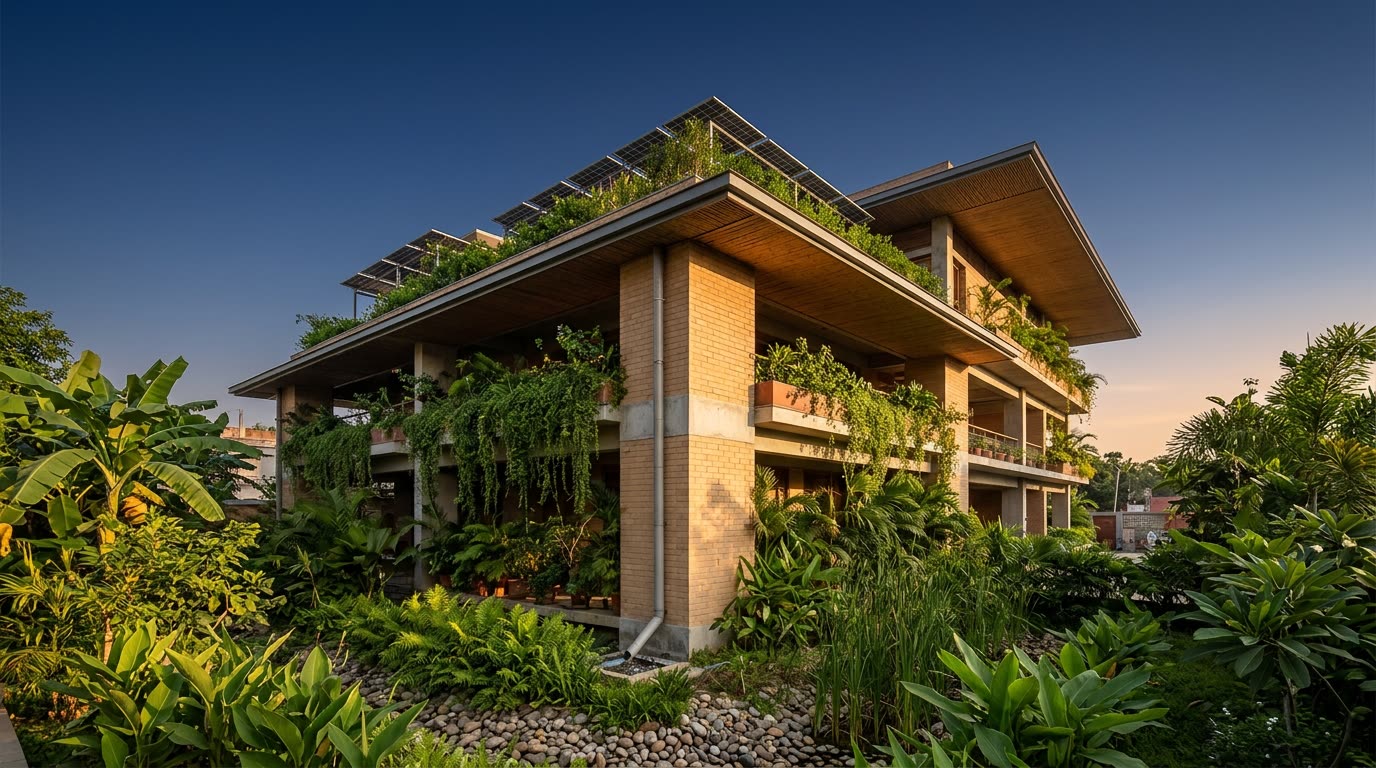
Sustainability in construction attracts a lot of signalling and rather less measurement. In a hot, humid, rapidly urbanising country with a strained grid, a few decisions matter far more than the rest.
Passive design before technology
The most effective energy measure is needing less energy. Orientation, shading, cross-ventilation, thermal mass and roof insulation reduce cooling demand permanently, require no maintenance and cannot be switched off. They also cost little when decided early.
A building designed to stay comfortable for much of the year without mechanical cooling has already outperformed one that offsets heavy consumption with solar panels. Solar is worth adding — after demand has been reduced, not instead of reducing it.
Cooling is where the energy goes
In this climate, cooling dominates operational energy. Reducing solar gain through the roof and the west facade, specifying glazing suited to a tropical climate rather than imported assumptions, sizing equipment correctly rather than generously, and zoning so unoccupied areas are not conditioned — these produce measurable savings.
Ceiling fans deserve more respect than they get. Air movement raises the temperature at which people feel comfortable, so fans plus a higher thermostat setting is dramatically more efficient than air conditioning alone.
Water, in a country with too much and too little
Dhaka's groundwater is under pressure while the city floods seasonally. Rainwater harvesting addresses both, and is simple when planned with the structure. Greywater reuse for flushing and irrigation makes sense at scale. Permeable paving and retained planting let water enter the ground rather than overwhelming drains. Efficient fittings are the easy part and should be assumed.
Embodied carbon is the overlooked half
Operational energy gets the attention; the carbon already spent making the building often rivals decades of its running emissions. Cement and fired brick are both significant contributors, and both are central to how Bangladesh builds.
The levers are using less material through efficient structural design, substituting where performance allows, sourcing from better-performing producers, and — most powerfully — retaining and adapting existing buildings rather than replacing them. The greenest building is usually the one already standing.
Durability is a sustainability strategy
A building that needs refinishing every few years consumes materials continuously. In this climate that means detailing for water, specifying finishes that tolerate humidity, protecting reinforcement properly, and designing for maintenance access. Longevity rarely appears in sustainability marketing and is among the most effective things a design can deliver.
Certification, honestly
Certification schemes are useful for structuring decisions and for clients who need third-party verification — Bangladesh's export-facing garment sector has driven real uptake. They are not a substitute for the fundamentals. A certified building with poor orientation and no shading is still a badly performing building.
Planning an architecture, interior or construction project in Bangladesh?